

 See My Latest Article on HelloNation

Sports injuries can affect weekend runners, high school athletes, recreational cyclists, weightlifters, and people who stay active through neighborhood courts, gyms, fields, and desert-season outdoor activities. Chiropractic care may help with certain muscle, joint, and movement-related problems, but it works best as part of a broader recovery plan rather than as a replacement for emergency care, imaging, surgery, or structured rehabilitation.
What types of sports injuries may respond to chiropractic care?
Chiropractic care is most relevant to injuries involving the neuromusculoskeletal system—the muscles, joints, ligaments, tendons, and nerves that support movement. Examples may include uncomplicated:
- Low back pain after lifting, running, or rotational activity
- Neck or upper-back stiffness after contact, falls, or repetitive training
- Muscle strains involving the back, hip, shoulder, or lower leg
- Joint stiffness following a mild sprain
- Movement-related pain associated with overuse or changes in training
- Restricted mobility that affects normal exercise technique
The usefulness of care depends on the actual injury. A mild soft-tissue problem may improve with activity modification, gradual exercise, and hands-on treatment. A torn ligament, fracture, dislocation, severe tendon injury, or significant concussion requires a different evaluation and treatment pathway.
Pain location alone does not identify the injured structure. For example, pain near the knee may originate from the knee itself, the hip, the ankle, or altered movement elsewhere in the leg.
How can chiropractic treatment support recovery?
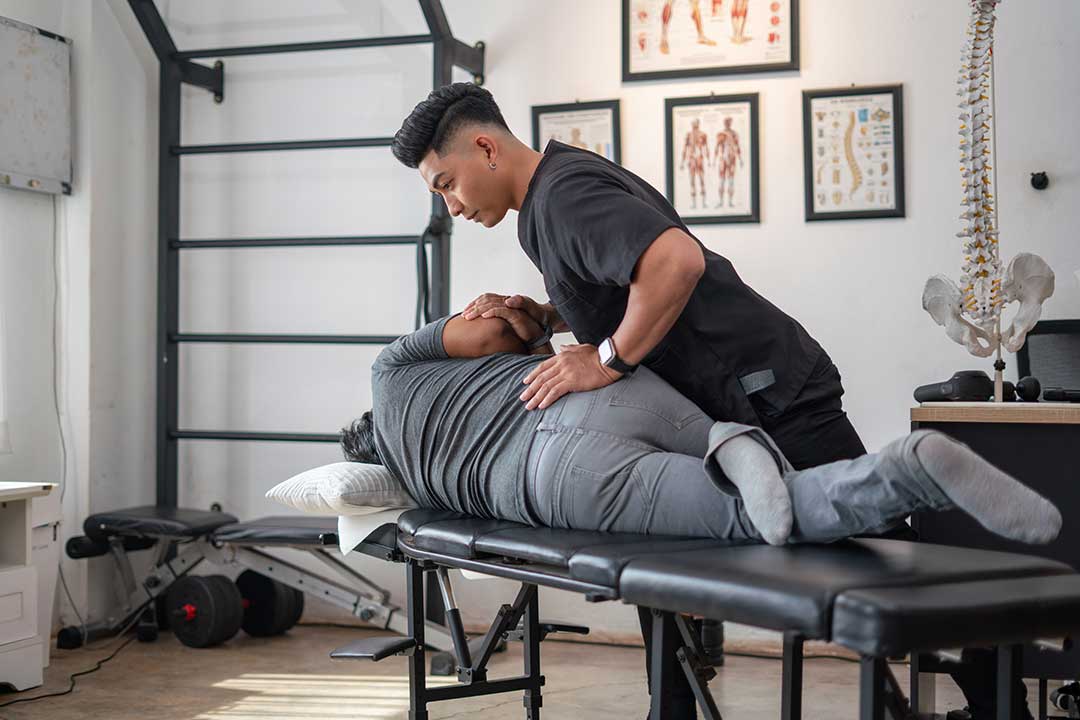
Chiropractic care may help reduce pain and improve movement through several approaches. Treatment is generally directed toward restoring comfortable motion and helping a person resume appropriate activity without repeatedly aggravating the injury.
Depending on the condition, care may include:
- Joint mobilization or manipulation
- Soft-tissue techniques
- Guidance on temporary activity modification
- Mobility exercises
- Strengthening and stability exercises
- Advice about posture, lifting, running mechanics, or training progression
Manual treatment can sometimes make movement feel easier in the short term. That improvement may allow a person to perform rehabilitation exercises with less discomfort. Exercise is usually the more important long-term component because strength, coordination, balance, and tolerance to load help the body handle the demands of sport.
For athletes with low back pain, research has examined exercise, biomechanical changes, and manual therapy. Exercise commonly improves pain and function, while evidence is less certain about whether spinal manipulation alone improves return to sport. This supports a balanced approach rather than relying on repeated adjustments as the only treatment.
Does chiropractic care “put an injury back in place”?
Usually, no. Many sports injuries are not caused by a bone being visibly “out of place.” Pain can involve irritated tissue, swelling, muscle guarding, reduced joint motion, altered coordination, or an excessive training load.
A manipulation may change joint motion or temporarily reduce the feeling of stiffness, but it does not repair a torn ligament or instantly heal damaged muscle fibers. Recovery still depends on the type and severity of the injury, protection of the affected area, gradual loading, sleep, nutrition, and time.
This distinction is especially helpful for athletes who feel pressure to return quickly. Feeling better is not always the same as being ready for full-speed competition.
What does a safe recovery plan look like?
A safe plan progresses from basic daily movement toward sport-specific demands. The exact sequence varies, but many recoveries involve:
1. Initial protection: Reduce or modify activities that sharply increase pain, swelling, weakness, or instability.
2. Comfortable movement: Maintain gentle motion when appropriate so the area does not become unnecessarily stiff.
3. Restoration of control: Rebuild balance, coordination, range of motion, and basic strength.
4. Gradual loading: Increase resistance, distance, speed, or training volume in manageable steps.
5. Sport-specific practice: Reintroduce cutting, jumping, throwing, sprinting, contact, or lifting only when basic movements are tolerated.
6. Return-to-play monitoring: Watch for pain during activity, worsening symptoms later that day, and reduced performance the next morning.
In Gilbert, seasonal heat can add another variable for runners, outdoor athletes, and people training on paved surfaces. Dehydration, heat stress, and fatigue can affect coordination and increase the chance of poor movement decisions. Training earlier or later in the day, taking adequate fluids, and recognizing heat-related symptoms are separate but important parts of injury prevention.
When should an athlete seek medical evaluation first?
Chiropractic treatment is not appropriate as the first response to every sports injury. Prompt medical evaluation is warranted for symptoms such as:
- Inability to bear weight or use an arm normally
- Visible deformity or a joint that appears displaced
- Rapidly increasing swelling or extensive bruising
- Numbness, progressive weakness, or loss of coordination
- Severe pain after a collision or fall
- Loss of bladder or bowel control with back pain
- Chest pain, shortness of breath, fainting, or unusual dizziness
- Suspected concussion, especially with confusion, repeated vomiting, worsening headache, or unusual behavior
A suspected fracture, dislocation, major ligament tear, spinal cord problem, or serious head injury may require urgent assessment and imaging. Neck manipulation deserves particular caution after trauma or when neurological symptoms are present.
Even without emergency symptoms, pain that does not improve, repeatedly returns, or prevents normal movement may need a more complete evaluation. Continuing to train through significant pain can turn a manageable problem into a longer-lasting one.
Can chiropractic care help prevent sports injuries?
It may help identify movement limitations, strength deficits, or training habits that contribute to repeated symptoms, but no treatment can guarantee injury prevention. Prevention is usually built from several practical habits:
- Increase training volume gradually rather than making sudden jumps.
- Strengthen the muscles that support the hips, knees, shoulders, trunk, and ankles.
- Practice the movement patterns required by the sport.
- Use appropriate footwear and replace worn equipment when needed.
- Warm up with dynamic movement before intense activity.
- Allow recovery between demanding sessions.
- Avoid returning to full competition simply because pain temporarily improved.
A movement assessment may reveal that an athlete is compensating for limited ankle mobility, poor hip control, weak shoulder stabilizers, or inadequate trunk endurance. Correcting those factors can be useful, but the findings should be interpreted carefully. A small asymmetry is not automatically an injury or a reason to stop participating.
What should athletes expect from an evaluation?
A thoughtful evaluation should include the injury history, the activity that caused symptoms, current pain behavior, relevant medical conditions, and a movement or neurological examination when appropriate. The purpose is to determine whether conservative care is reasonable and whether another type of evaluation is needed.
A clear plan should explain what activities to pause, what movements are acceptable, which exercises are appropriate, and what signs indicate that symptoms are worsening. Treatment should be adjusted if progress stalls.
For local athletes and active households, the most useful question is not whether chiropractic care is universally good or bad for sports injuries. The better question is whether the specific injury, symptoms, examination findings, and recovery goals match a conservative plan that includes appropriate exercise and safety screening.